Before Editing
Film began as a single 45 second shot, there was no editing eg, transitions or any other shot to follow. The first use of film was shot on a Cinematographe, an all in one camera which also could be used as a projector and developer. The film had no sound, no colour and was shot in a 4:3 ratio, although very square.
The first pioneers to create a moving image and film was the Lumiere brothers, they shot the first film called, 'la sortie de l'usine lumiere a lyon' which translates to workers leaving the Lumiere factory produced in 1895. The Lumiere bros however, did not produce the first ever cinematographe, which in actual fact was Leon Guillaume Bouly 1892, instead the Lumiere bros patented the film perforations (holes in the film.) This in turn allowed the film to move through the camera, and thus allowed to create the first film. The film itself is single shot of the Lumieres factory employees leaving, there is no story, no acting or story telling, but rather it is a shot of realism, the camera is set up and they just recorded something very simple. The Lumiere's further produced another film called, 'L'arrivee d'un train en gara de la ciotat'. This film showcased a train that was pulling into the station and framed on the left hand side, whilst by the end of the film people were getting off and on.
Whilst this film was not particularly successful, it was the start of something. It was the start of a moving image that could also be projected on a screen for viewing.
Another pioneer for the start of film would be George Albert Smith, he was perhaps a little more advanced then the lumiere Bros as he used the already made equipment to project a story on screen. His first pieces of work including The Miller & The Sweep, was a short 0:35 second single shot film. It was a comedy stemming from his wife's work in pantomime. His most notable work though came later in 1899 called Santa Claus, this was a longer film at 1 minute 16 and has been said that its the earliest example of crosscutting, which also used a number of special effects created. Smith was a pioneer because he did something different with film, whilst it was not his main profession, he was able to produce something that carried meaning. His work told a story and this was the first time that this could have been done through film and not literature.
In-camera Editing
In-camera editing essentially was a stop and start technique, it was a cinematographic edit which meant filming in a sequence. The basis of this technique is that everything is strictly shot in the exact order, this would mean that the physical process of cutting the film and editing is eliminated. Whilst this would save time it doesn't account for any mistakes in the process of filming.
Robert W. Paul was the first pioneer to use this technique, his film in 1898 Come along, Do! ran for 1 minute and was the first time that we saw multiple shots in one film. The first shot denotes a simple long shot, much like films before this one, and used a man and his wife sitting outside having a drink before they go into a museum. However, only 38 seconds of the film has survived and the second shot that follows has been lost, this is why we can only see it in stills. However, it still does show the progression of film, the very fact that it did have a second shot meant that we could see a clear example of continuity and a linear format to filming. Robert W. Paul was also the first person to feature reverse cranking, which meant that the film in the camera could be exposed multiple times and create a super exposure. This technique was first used in his film, Scrooge or Marley's Ghosts, which was the oldest film adaptation of a Christmas carol. His pioneering techniques meant that a further story could be developed, it allowed for a continuity sequence and thus an improvement on George Albert Smiths work. This process was particularly easier for editiors, they no longer had to cut and stick the film together multiple times, instead as everything was already strictly shot they just had to stick everything together.
Robert W. Paul was the first pioneer to use this technique, his film in 1898 Come along, Do! ran for 1 minute and was the first time that we saw multiple shots in one film. The first shot denotes a simple long shot, much like films before this one, and used a man and his wife sitting outside having a drink before they go into a museum. However, only 38 seconds of the film has survived and the second shot that follows has been lost, this is why we can only see it in stills. However, it still does show the progression of film, the very fact that it did have a second shot meant that we could see a clear example of continuity and a linear format to filming. Robert W. Paul was also the first person to feature reverse cranking, which meant that the film in the camera could be exposed multiple times and create a super exposure. This technique was first used in his film, Scrooge or Marley's Ghosts, which was the oldest film adaptation of a Christmas carol. His pioneering techniques meant that a further story could be developed, it allowed for a continuity sequence and thus an improvement on George Albert Smiths work. This process was particularly easier for editiors, they no longer had to cut and stick the film together multiple times, instead as everything was already strictly shot they just had to stick everything together.
Following the Action
Following the action was a technique where the camera would cut multiple times throughout the film and 'follow the action.' The technique meant that there was clear examples of continuity editing as well as cutting between two actions. The technical aspects were much harder then anything that had been done before in terms of the camera language and editing.
George Albert Smiths later work though showed a development in editing techniques and the camera language in film. As seen through a telescope (1900) was a film that especially pioneered in the technical aspects of the film. With a duration of 1 minute the film denotes a man standing in the middle of the frame holding a telescope up, the film then cuts to a circle filter acting as the telescope, as we see a woman's ankle. The film then ends with a cut back to man who sits down feeling satisfied but is then knocked off his chair in a slapstick comical way. This film illustrates the evolution of post production, George Albert Smith was able to not only cut and follow the action multiple times but he was able to add in a filter which had never been done before. The ability to change the frame to a circle and carry on the story was exceptionally pioneering to post production and film. As seen through a telescope was very similar to another film of G.A Smiths called Grandmas reading glasses, which was also created in the same year, showed clear examples of close-ups which at the time was revolutionary. This film used a magnifying glass to again create this circular frame but it also highlighted the use of a close-up. Both films clearly denote this advancement in film and post production, they pioneer in the camera language that they use and the number of cuts & different filters, to really add another element to the story that they tell. This of course meant that the editors job was more intensive, they now had to cut the film precisely so that the film was able to tell the story in the smoothest way possible. But this advancement in film did mean that, for editiors, they had to be more refined which only improved the technical skills of the profession.
George Albert Smiths later work though showed a development in editing techniques and the camera language in film. As seen through a telescope (1900) was a film that especially pioneered in the technical aspects of the film. With a duration of 1 minute the film denotes a man standing in the middle of the frame holding a telescope up, the film then cuts to a circle filter acting as the telescope, as we see a woman's ankle. The film then ends with a cut back to man who sits down feeling satisfied but is then knocked off his chair in a slapstick comical way. This film illustrates the evolution of post production, George Albert Smith was able to not only cut and follow the action multiple times but he was able to add in a filter which had never been done before. The ability to change the frame to a circle and carry on the story was exceptionally pioneering to post production and film. As seen through a telescope was very similar to another film of G.A Smiths called Grandmas reading glasses, which was also created in the same year, showed clear examples of close-ups which at the time was revolutionary. This film used a magnifying glass to again create this circular frame but it also highlighted the use of a close-up. Both films clearly denote this advancement in film and post production, they pioneer in the camera language that they use and the number of cuts & different filters, to really add another element to the story that they tell. This of course meant that the editors job was more intensive, they now had to cut the film precisely so that the film was able to tell the story in the smoothest way possible. But this advancement in film did mean that, for editiors, they had to be more refined which only improved the technical skills of the profession.
Multiple points of view
This next pioneering technique was the first use of the 180 degree rule in film as well as seeing some crosscutting. This technique meant that the film had to be much longer, as we saw more or the remnants of film like today.
James Williamson produced a film called, Attack on a mission station. The film denotes these Chinese rebel fighters raiding a missionary family, to which British sailors come and rescue the family by fighting off the rebels. This film was the first time that we saw other camera techniques being used, and other editing techniques being used. This film connotes the first use of the 180 degree rule, adding another element to continuity editing. What perhaps set this film even further apart is the first use of, 'match on action' as the sailors come in to shot and run across the screen, the camera then cuts to them continuing to run. This film is perhaps closer to what we are used to in present day, it has a definitive story being told and whilst there are no close ups or filters used in this film, the story is still able to advance through the technical aspects. Attack on a china station was a huge success when released, it is a shame that over half the footage has been lost today, but it does still show clear examples of the techniques. The film was inspired by Georges Melies, 'L'affaire Dreyfus' which was an 11 installment series of the Dreyfus affair that had been happening at the time (1899.) Whilst Attack on a china mission station was not the first war based film it was still something so successful in story and technique that it pushed film forward. Attack on a mission station incorporated a number of technical skills that had never been seen before in a film, it meant that editors really had to be precise about where they cut and how they produced the scene. Editors had never had to cut a film were there was a 180 degree rule or crosscutting had been used before, which mean they really had to learn more in depth of how to construct a scene.
James Williamson produced a film called, Attack on a mission station. The film denotes these Chinese rebel fighters raiding a missionary family, to which British sailors come and rescue the family by fighting off the rebels. This film was the first time that we saw other camera techniques being used, and other editing techniques being used. This film connotes the first use of the 180 degree rule, adding another element to continuity editing. What perhaps set this film even further apart is the first use of, 'match on action' as the sailors come in to shot and run across the screen, the camera then cuts to them continuing to run. This film is perhaps closer to what we are used to in present day, it has a definitive story being told and whilst there are no close ups or filters used in this film, the story is still able to advance through the technical aspects. Attack on a china station was a huge success when released, it is a shame that over half the footage has been lost today, but it does still show clear examples of the techniques. The film was inspired by Georges Melies, 'L'affaire Dreyfus' which was an 11 installment series of the Dreyfus affair that had been happening at the time (1899.) Whilst Attack on a china mission station was not the first war based film it was still something so successful in story and technique that it pushed film forward. Attack on a mission station incorporated a number of technical skills that had never been seen before in a film, it meant that editors really had to be precise about where they cut and how they produced the scene. Editors had never had to cut a film were there was a 180 degree rule or crosscutting had been used before, which mean they really had to learn more in depth of how to construct a scene.
Shot Variation
Shot variation was an editing technique that allowed for different transitions eg, dissolves, fades. It was the ability to cut between different frame sizes, and have a wider range of shots in one film to produce certain emotions.
DW Griffiths produced the famous, 'The birth of a nation' a film based on the the civil war and the battle between races after. The film was the first to really have length to it with a run time of 133 minutes, and for some people where film all began as it is considered the first ever feature film. DW Griffiths was especially innovative in this film explicitly showcasing very different techniques that had never been done before including, flashbacks, crosscutting, and close-ups. Whilst George Albert Smith had already used close-ups in his work, this was the first time that they carried a specific meaning. These close-ups were meant to evoke certain emotions within the audience and really engage the audience with what was precisely happening in that scene. Whilst the content of this film was radical and shocking to everyone, the technical aspects of this film carried brilliance. DW Griffiths was able to create something that others had been trying to do for years, he managed to turn film into a business, which was ultimately what Lumiere Bros attempted, George Albert Smith attempted to do aswell. Whilst they were pioneers in the industry they were never able to really produce a sufficient business. Dw Griffiths also produced a film called, 'Intolerance' which was 4 stories that were intertwined and parallel to each other throughout the 3 hour epic. The film was believed to be a response to The birth of a nation which was widely criticized for its racism. The film however was not widely received domestically but again was a technical masterpiece and would be a major influence later on. For editors as this was the first feature film, it meant that they had a much longer time to frame to keep to. This was also the first ever time that editors had to really keep to a structure of scene after scene, and have a concise beginning, middle and end.
DW Griffiths produced the famous, 'The birth of a nation' a film based on the the civil war and the battle between races after. The film was the first to really have length to it with a run time of 133 minutes, and for some people where film all began as it is considered the first ever feature film. DW Griffiths was especially innovative in this film explicitly showcasing very different techniques that had never been done before including, flashbacks, crosscutting, and close-ups. Whilst George Albert Smith had already used close-ups in his work, this was the first time that they carried a specific meaning. These close-ups were meant to evoke certain emotions within the audience and really engage the audience with what was precisely happening in that scene. Whilst the content of this film was radical and shocking to everyone, the technical aspects of this film carried brilliance. DW Griffiths was able to create something that others had been trying to do for years, he managed to turn film into a business, which was ultimately what Lumiere Bros attempted, George Albert Smith attempted to do aswell. Whilst they were pioneers in the industry they were never able to really produce a sufficient business. Dw Griffiths also produced a film called, 'Intolerance' which was 4 stories that were intertwined and parallel to each other throughout the 3 hour epic. The film was believed to be a response to The birth of a nation which was widely criticized for its racism. The film however was not widely received domestically but again was a technical masterpiece and would be a major influence later on. For editors as this was the first feature film, it meant that they had a much longer time to frame to keep to. This was also the first ever time that editors had to really keep to a structure of scene after scene, and have a concise beginning, middle and end.
Manipulation of diegetic time and space
This was the first time in film that we saw montage editing or as it was called, 'rhythmic montage.' It was more different to what we are used to today but the idea was still there. This technique wasn't so much a collage of short clips but rather a highlight reel of sorts.
Sergei Eisenstein produced a film called Battleship Potemkim, the 5 act film where by the crew of the ship rebel against the officers. Most notably is the 4th act, 'The Odessa Steps' this was where for the first time we saw a montage cut to the beat of some music. During the act where chaos is happening on the stairs we see a number of camera angles being used to focus on various pieces of action, and thus creating a montage of sorts. Whilst there is a music composition that happens throughout this scene, it perhaps is more notable where the soldiers seem like they are marching to the music. Eisenstein used the advances in post production, to overlay the music and create this, 'rhythmic montage' which not only was groundbreaking but he also created meaning to it as well. The ending made it possible for the audience to feel sympathy for the crew as they had lost that particular battle yet it foreshadowed that they would rise up and ultimately win. Of course its main purpose was to create this intense, gripping scene that could be presented in a more artistic way. For editors the use of rhythmic montage allowed them to condense time within the scene, and gives the scene better aesthetics. Whilst it perhaps gives the editors more structure it does give them a more creative freedom with the mix of sound and visuals.
Film,Video
In 1951 video was first invented, yet it took over 51 years for video to actually be used in the production of professional films. It was only until 2001 where video had a superior definition to film and became easier to use.
Once upon a time in Mexico directed by Robert Rodriguez was the first ever film to be shot of digital video as opposed to film. The sequel to El Mariachi and Desparado it was Antonio Banderas last appearance as El Miriachi a drug lord. The film had a budget of $29 million the first big budget film to use the video format, and to release the film in digital format too. For the industry of film it meant that there was a complete technological convergence and everything became easier. It was easier to edit, easier to distribute etc. The very fact that a film could be edited and distributed all on one single device was revolutionary, and much like DW Griffiths it really pushed film into a completely new direction. Video made an editors job more accessible, with film they had to be very careful because it could easily get damaged or lost. But with video all the footage was stored on the tapes, which meant that management and storage became a lot easier when editing a film.
Once upon a time in Mexico directed by Robert Rodriguez was the first ever film to be shot of digital video as opposed to film. The sequel to El Mariachi and Desparado it was Antonio Banderas last appearance as El Miriachi a drug lord. The film had a budget of $29 million the first big budget film to use the video format, and to release the film in digital format too. For the industry of film it meant that there was a complete technological convergence and everything became easier. It was easier to edit, easier to distribute etc. The very fact that a film could be edited and distributed all on one single device was revolutionary, and much like DW Griffiths it really pushed film into a completely new direction. Video made an editors job more accessible, with film they had to be very careful because it could easily get damaged or lost. But with video all the footage was stored on the tapes, which meant that management and storage became a lot easier when editing a film.
Analogue
Analogue editing meant that film could be edited through a machine, which was a completely different way of editing as previously everything had been done by cutting the film reel and sticking it back together. Whist this machine essentially did the same thing it was considerably easier for editors.
In 1917 Iwan Serrurier a dutch born engineer invented the first moviola which its intended purpose was to project film for peoples homes. This moviola was similar to something that already existed called a victrola, this was a phonograph but was redesigned to look more fitting for a home and less like a whole machine. The moviola was not selling well to the public in america as it cost so much, in 1924 Iwan adapted the moviola machine so that editors could use it, rather then being a projector it became an editing machine. This piece of equipment changed post production, it wasnt so drastic like digital editing but it did change the way editors edited. The whole process became easier and faster, the machine also allowed for different transitions to be used and this allowed for post production to again change its ways. For an editor the moviola didn't necessarily mean their job got easier, but it did give them their own machine and their own space to edit from. Whilst the moviola was a very, 'hands on' machine it allowed editors to have a trust and a confidence in editing, the machine never changed and they could learn and know every part of the machine.
Digital
Digital editing or non-linear editing was a non destructive way of editing, there was no physical cut of any film reel, and everything was done on computers, opposing moviolas.
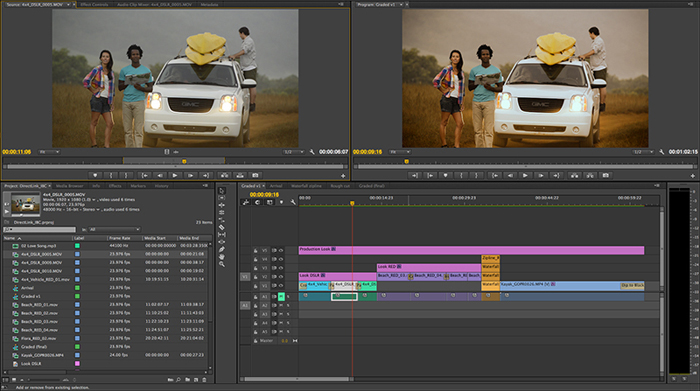
The first non-linear editing system was the CMX 600 introduced in 1971, however it was low-resolution and only in black and white making this product not fit for professional editing. During the 70's and 80's various editing systems were invented but nothing substantial came until 1985 when Ediflex was invented. Ediflex was used professionally for many years, whilst new systems and software where being invented however most failed. 'Lets kill the lawyers' was the first film that was completely edited on a PC, directed by Ron Senkowski and was based on Shakespeare's Henry VI play. The film was not widely received by anyone and had reviews calling it ,'a bad homemade film.' However the main point of the film is that it was the start of something, much like the Lumiere Bros back in 1895 there was a revolutionary idea with this film. The start is never easy and whilst perhaps it was easier to use older techniques that had been perfected this was a format that would again push post production forward. Digital editing on a PC was and is easy there is no destruction of footage, and content can be edited faster and cheaper and it allows for more special effects to be added. By having multiple software's to edit on, it means that anyone can learn to edit, we no longer need big units to cut up film, but rather all we need now is a computer. The advancement of digital editing packages has meant that editors now have a much easier job altogether, from storing footage to having multiple cuts of some footage, as well as the added advantage of no longer loosing footage that easily anymore.
Other notable software's such as final cut were invented in 1998, Adobe premiere pro wasn't invented until 2003 whilst Apples Imovie was invented in 1999.



No comments:
Post a Comment