Tuesday, 27 December 2016

Technical Evaluation of Ultra Short Film

Appropriate Techniques 

Throughout my ultra short film i have used various techniques, including jump cuts and parole editing. Jump cuts is a technique in which the camera stays in one stationary position, but the action is cut forward in time.
This can be seen in my ultra short film at (1:00) here we see the camera in a low angle, long shot but the action of myself getting up and walking away is cut 3 times. This connotes the speed up of time in this scene and mainly tries to get the ending shot of the scene to start and finish quicker. This is because the shot needs to be there for continuity but as i have cut the shot it speeds it up and adds to the style of the film.
The jump cuts in this instance are not only used to speed the shot up, but its also used to continue the style that I wanted to create throughout the film. The jump cuts have allowed me to continue this jolting style that was scene at the start of the film.  


Appropriate Transitions

During my ultra short film, there was multiple transitions that ranged from cuts, to screen wipes. The screen wipe, is a transition where one shot is layered on top of another, the existing shot then diminishes from left to right as the second shot moves through the screen.
At (1:39) we see the screen wipe that i have used, whereby one couple are standing at the front door and come together to hug, as the camera is tracking from right to left, the next visual then comes into frame from left to right, whilst the camera movement continues into this second shot. The second shot is again a similar set up as the camera continues to track from right to left, with again a character standing at the door and waiting to go in.
This transition is something that can be used for various situations, whilst it does have potential to have a comical connotation, in this instance, it was used to reveal the narrative. Whilst the scene leaves the audience asking questions, the transition almost acts as the answer and the big reveal as to where the main character has gone. The screen wipe acts as a very smooth transition to move the narrative along in perhaps a more technical way.


Appropriate Conventions

During the ultra short film there was many conventions that was used including cutaways. Cutaways are shots that visually show one thing but the audio or dialogue is coming off screen. Whilst this shot acts as a filler shot it also allows the scene to move on quicker but also gives the audience a chance to look at one thing whilst hearing another.
At (1:59) we see the camera pan from right to left as the main character walks into shot to go sit down, but the dialogue is off screen saying, 'through here, yeah.' This shot allowed the continuity of the scene to be shown but in a swiftly manner, i was able to move the scene along and get to the real crux of the scene whilst still able to have the technique.
This transition really helped me to move the scene along, because I needed to stick to the time constraints but also needed to make sure i had the continuity of the scene. It also makes the scene smoother as we could transition from walking into the house to sitting at the table during the conversation.  


Effective Pacing

Effective pacing is through the short film we see two clear distinctions of pace to portray certain emotions in different situations. They allow the filmmaker to add intensity or take it away depending on what atmosphere they want to create.
At (0:17) we see at the beginning of the short film they are multiple fast paced cuts to create an anxious, flustered atmosphere from the drugs that the character has taken. However at (0:42) the pace considerably drops as we go through the flashback scene. By using longer shots and slowing down the pace, this creates a very different atmosphere, instead of feeling very frantic it is more subdued and sad which is the main aim of the scene.
By having two different editing paces, it firstly allows the audience to see a clear representation of how drugs effect the person directly, but secondly it manipulates the audiences emotional state through the short film. As a filmmaker editing paces is very effective way of controlling the audience and making them translate their feelings to the characters to provide empathy.

Convey Information Effectively

Conveying information effectively simply means the visual and audio matches to correctly relay information to the audience in a clear way which is needed, especially in a short film from a narrative perspective.
At (0:29) we see the main character sitting down but then we actually hear a notification sound from the phone. This would simply convey the information that the character has a text message which becomes a pivotal point in deciding where he will go. Again at (0:51) we hear the same sound indicating another text message, to which we see the first one was from the girlfriend which intrigues the audience to see who the second message is from.
The short film conveys information correctly through the use of audio and visual, a short film does not have the time to convey a complex narrative which can be revealed by small details. This in turn, means that the short film needs to be more obvious when conveying information so that the audience dont have to think about the narrative and instead really invest their time in the emotional side of the short film.


Use Sound to Create Impact

Using sound to create impact is whereby the the audio evokes a certain emotion within the audience, or tries to create a certain atmosphere during the scene. Sound may also be used to reveal information within the scene.
At the start of the short film (0:04) we hear a slow paced heart beat sound, this created a slow, eary atmosphere surrounding the scene. However at (0:15) the heart beat sound effect had considerably sped up, which has changed the atmosphere of the scene but also the emotions that the audience are feeling. Here we can see the use of the heart beat sound effect being used to create impact in terms of the atmosphere that it creates.
The use of sound through this scene has not only allowed the intensity of the scene to significantly increase, but it has also heightened the emotion for the audience. The anxiety levels of the audience are constantly rising because of the heart beat sound effect.


Synchronize Sound and Vision

Synchronising the sound and vision is simply cutting to a soundtrack, this is when we cut the visuals to the beat of the music.
My ultra short film had a number of places where i cut to the beat but at 1:12 we see the technique being used more clearly. Here we see the character walking and waiting for someone to come, during the edit though the scene cuts multiple times, on every beat. This in turn does continue this theme of the short film being more 'jolty' and jarring.
Cutting to the beat allows the audience to be more entertained, through some scenes which may not necessarily be exciting by themselves. Whilst some scenes are needed either for continuity etc, cutting to the beat allows the audience to be kept engaged when watching these scenes.


Mix Soundtracks

Mixing soundtracks is where soundtracks are overlapping and the levels are changed so that one can be heard more then another, eg music and dialogue.
At (1:30) we see the beginning of a conversation between two characters happening, however we hear that the end of one piece of music fading out and a new piece of music fading in. Except the music stays at a lower level which allows the audience to hear clearly what is being said as opposed to being droned out by the music.
Mixing soundtracks enables for a clear distinction between emotion and reality, the manipulation of the audiences emotions stemmed from the music that overlaid the visuals. However when a conversation happens that's when the audience are brought back to reality and grasp the narrative.

Overlap Sound

Overlapping sound is when more then one audio track is used laid over the visuals of the short film. Overlapping sound can vary from sound tracks to dialogue or just a simple wildcat used.
At  (0:46) we hear 3 soundtracks overlapping each other, the first being a wildcat soundtrack of the surrounding background noise, the second soundtrack used was the voice over between the 2 characters telling each other that they love on another, and the last sound track was the music that continues to play in the background.
By overlapping the soundtracks it allows the filmmaker to create a certain emotion surrounding the scene. It allowed me to both show a clear narrative but further extend the emotion of the scene by using the voice over, however the music in the background heightens the saddened emotion that the audience are feeling at that very point.


Offline Edit/Online Edit

Offline editing is the process of going through the script and seeing what was filmed, deleted or changed etc. Opposed to online editing which is using the editing software to physically manipulate the footage into a finished product.
The offline editing process was the first job to do in the post-production stage, it consisted of me going through our shooting script and checking through what i had filmed and what we had decided to change on the days of production. During the online editing though is where i used the software to piece together the final product, i was able to use a number of effects and technical skills to portray a more emotional piece.
The purpose of offline editing is to be more organised when online editing. It allows the editor to have structure and to know what was shot and what was changed, making it easier for them to construct the short film. In terms of online editing this is the final stage in production, and perhaps the most crucial, it is where the themes, and emotions of the film can really come out which is whats needed to keep the audience engaged and excited.


On Screen Text

On screen text is the graphics and typography that are used mainly at the beginning of the film and at the end. They are the opening credits and title of the film and the ending credits of the film.
At (0:01) we see the title of my film come on screen which is all the screen text that was needed for the short film. Then at (2:25) we see the credits that scroll up the page featuring cast and crew that worked on this project. My on screen text was very simple mainly because i didnt want to distract the audience away from the actual ultra short film.
On screen text helps the audience to understand the narrative of the film, however during an ultra short film where there is not much spare time, it does need to be portrayed in a more quicker manor so that the audience can focus solely on the film.


Image Editing

Image editing is where the raw footage is taken and changed in various ways to produce a sequence, thus creating the short film.
At (0:05) we see the first visual of the ultra short film, in which the main character is sitting down in a slumped position starring at the TV, which is off screen, as the camera tracks inwards. The image though has been edited, as it firstly was cut down at the beginning and at the end because it didn't need to be the full clip length. But also the image has been colour corrected meaning image slightly has this blue tinge to it allowing the white T-shirt to almost stand out more.
The effect of image editing, allows the visuals to look more aesthetically pleasing for the audience, it gives the visuals a chance to look more professional and higher quality rather then leaving the colours raw. Also by colour correcting it means that the image feels warmer, or more distant and coupled with the audio it again manipulates the audiences emotional response to the scene.


Audio Editing

Audio editing is the editing of the audio that is used throughout the short film, this can vary from effects added to the audio or where it is cut and lowered in its levels.
At (0:27) we hear the heart beat sound effect fade out, in time with when the visuals fade out too. This then puts a stop to that scene and the intense emotion that the audience was feeling, the music then fades in to the next scene. This allows the audience to start investing their time into the narrative and start feeling new emotions towards the character as we unveil their struggles.
Audio editing, allows the filmmaker to further manipulate the audiences emotions and further allows them to decide when the scene should come to an end point and move on. Audio editing also makes the visuals feel fuller, it creates more meaning as opposed to having sound from the footage or just silence which would not engage the audience as much.

Sunday, 11 December 2016

Preparing Footage for Editing

Monday, 5 December 2016

Process Evaluation of Ultra Short Film

Software Applications

The software applications is the editing software that was used for the post production of the short film. It is a digital, online platform where footage can be manipulated in various ways.

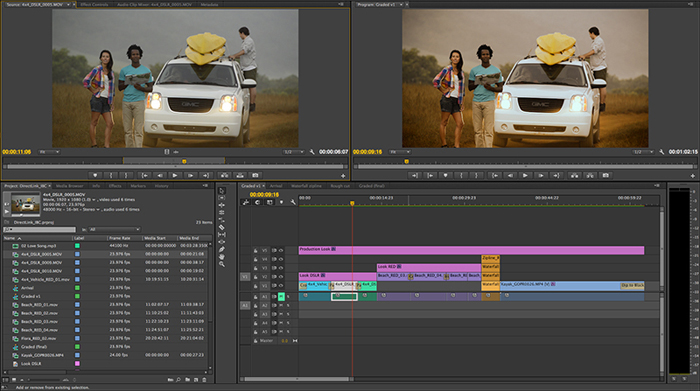
The software application that i used to edit with was Final Cut X, this particular application can only be used on Apple products, however it is one of the leading editing software's. Final Cut really allowed me to use more advanced settings in terms of colour grading and sound.

This software application has really allowed me to create a narrative with a high technical standard. Ive been able to use many different elements and tools from the software and create a film that was both narratively and technically strong.


Hardware

The hardware is the physical piece of equipment that is used to store and use software applications. Hardware, for editing, can range from an iMac, PC, or a laptop and even in some cases a tablet.

For our project we used an Apple iMac as our hardware, this allowed us to use Final Cut X  and to edit our projects on.

In terms of our ultra short film, using an Apple iMac meant the whole of post-production was easier. It is a very accessible system which allowed me to transfer the files easily from the SD card to the mac and from the mac to the editing software.


High definition/Standard Definition

Standard definition and high definition is the resolution that the footage has been filmed in and the resolution that the film gets edited in. The difference between standard definition and high definition also is the frame rate at which the footage is shot in, e.g. 25 fps, 60 fps. 

My ultra short film was filmed in high definition in 1080p at 25fps, i then further edited the film also in 1080p and 25fps.

The effect that HD has on my film is to get the best quality possible for the audience, they need to see a clear picture and have crisp audio to listen to. However in my case i rendered in 720p instead of 1080p, whilst this still is a HD file and not as a big of a file it doesn't have the same quality as a 1080p file. 


Tapes

Tapes are the types of storage for the footage, e.g. a SD card. It is a piece of hardware that stores all of the footage, visual and audio, and can further transfer it onto the iMac for editing.

I used an SD card, as my storage of tapes, as they was easily accessible for the compatibility between the camera to uploading it on to the editing software.

We used an SD card for our tapes, because it was the only piece of hardware that was compatible with the camera. It was also very easy for us to use as we could just slot it into the camera and then slot it into the iMac, with minimal problems.


Hard Disc

The hard disk is the hardrive of the computer, it is where everything is stored and uploaded too. This piece of hardware is where everything is saved, from the raw footage to the Final Cut file and the rendered video file.

For our ultra short film as we used the iMac's hard drive, we used the local hard drive storage. The macs hard drive is 1tb in size and stored all of my raw footage, audio edited file and the final .m4v file.

As we used a local hard drive which is an internal hard drive, as opposed to an external hard drive it becomes slightly more reliable but it is just easier and quicker to use. When using an internal, local hard drive everything is easily accessible, in comparison ton external hard drive which requires more cables etc. 


Data transfer rates

Data transfer rates is the speed in which the footage is uploaded to the hard drive. It is the time it takes for all of the raw footage files to transfer on to the mac, with different types of tapes taking longer then others to upload.

As we used an ultra 10 speed SD card, the data transfer rate was 90mb/s which is particularly fast. 90mb/s means that it took 1 second for 90mb of footage files to upload to the Mac.

This in effect just speeds up the process of uploading footage, it meant that i could start my editing and my preparation for editing quicker because the data transfer rate was fast. Some SD cards are not as fast which meant others would have had to wait a longer time for their footage to upload but it was quicker for me.

Exporting productions

Exporting productions effectively is rendering the ultra short film, it is the final stage of post-production and is where we chose what file format and what quality we want our film to be.

My ultra short film was rendered in HD quality which was 720p at 25fps. This meant that the file was reasonably small and meant that the rendering time was quick as well as the upload time to YouTube was also very short. Whilst it was not the highest quality i could have chosen it was the most suitable for the time period that i had.

By rendering in 720p it meant that the file size was small which was ideal for my situation. I needed a file that was HD quality but also it was something that could be uploaded anywhere very easily and quickly. If i did have more time I would have chosen to render in 1080p at the very least to improve the quality but that would have taken more time.  


File types

File types are the different formats that files can come in eg, .mov, .mp4, .m4v etc. These file types can also mean that only some platforms can open and watch them.

The file type that i exported my ultra short film in was .m4v. This file format is compatible with most platforms, it can be viewed by PC and by mac which is ideal for distribution, it also was accessible for YouTube too.

I chose to render in .m4v because it was accessible for many platforms, in some cases such as .mov files whilst they all work for apple, there can be problems when trying to access them with some PC software's. By choosing .m4v it allowed me to be quick with uploading and also i could transfer the file across many different platforms which is what i needed for this project.


Compression

Compression is the final stage of post-production, it is where the Final Cut file is rendered and compressed down into a smaller file. It renders the file into the desired resolution e.g. 1080p, and creates a file thats accessible to watch. 

I compressed and rendered my ultra short film into a 720p .M4V file which was a 312mb file. However when the file is uploaded to YouTube the file is then compressed again to make it compatible with YouTube. 

Whilst I compressed my file down to 720p .M4V it meant that it was quick to render and quick to upload. However this meant that i did loose some image quality and .M4V is not particularly compatible with every device, it would have been better to render in a .MP4 file. Furthermore, when YouTube has processed the video, the file again further loses some quality. 

Monday, 7 November 2016

Production Reflection

What were the main strengths of your production phase?

The main strengths of our production was how we all equally shared the responsibility to get things done and to a high standard. We showed great teamwork to come and film during some unsociable hours. We communicated well which enabled us to get our pre-production done quicker, giving us more time for production. Another strength that we showed through production was the ability at a good quick pace, whilst we didn't use many locations we did need various actors in various scenes, so we needed to be quick and organised to film certain scenes at certain times.


What challenges did you face during the production phase and how did you overcome them ?

The main challenge that we faced was simply to get all the actors to come at certain times, we wanted to really make sure every actor really suited the part. As such the people that we did cast were more scattered, so it did become a challenge to get everyone to help out at certain times. We managed to overcome this small problem by being really organised during our production days, thus allowing ot get all of our filming done on time.


What changes did you make from your planning? Why did you change these things? What was the impact of these changes?

From our pre-production planning we had originally stated we was going to use Seven kings park as one of our locations, we also stated that we would Iris as an actor but due to some difficulties we had to cast someone else more last minute, We lastly changed some of the actions that was on the shooting script, originally we was going to have our main character dancing as part of the montage, however after some deliberation we decided to change it to eating an egg. We changed the location because of some logistical reasons, it was also quieter to film at whilst still offering the same setting and atmosphere that the previous location would. We further changed the action in the montage because we felt that it wouldn't flow as well as we had hoped for. The changes that we have made didn't necessarily impact us greatly, we was still able to film everything how we wanted and even some of the changes actually made it easier for us to film the scenes. 


What improvements would you make to your production process if you were to do it again?

If we were to do it again i would have liked to film certain scenes multiple ways because i feel during post-production it would have been better t have more choice. I felt that some of our scenes were more limited because we only filmed some things once and only in a certain style.


Sunday, 23 October 2016

Shooting Script

Logistics Paperwork

Thursday, 20 October 2016

Proposal


What is your genre?

The genre for our ultra short film will be British Realism, with the sub genre being thriller. We want the audience to constantly sit on edge whilst also really relate to what we are showing them. We feel that the success of the film will stem from the emotional connection the audience has with the charcaters. We feel that our film is perhaps less about the plot line and more about the emotions that each character goes through. Each scene is based on the decisions that our characters make, which perhaps is the ultimate message we aim to pose the question to the audience about why we make certain choices in this world and what purpose do they carry. The film uses many elements of British Realism through its use of drugs, and the ease of obtaining them and further, by exploring the fragile relationship he has with his girlfriend, it shows the grit and struggles of life, which is something our audience would really relate too. 

Who are your characters?

Our characters consist of 1 female and 3 males. The main character will be a white younger male, addicted to drugs with a fragile relationship with his girlfriend. His girlfriend is a white, long brown haired younger woman, who is having an affair with another man, she is on edge with the relationship and can not understand the position she is in. Our drug dealer character will be a black male, slightly older then the other characters, he goes about his business playing as a side character. Lastly we have another male, similar height and build to our main character, which will only appear for one scene. He is the lover which simply knocks on the house door of the girlfriend.

What is your setting?

The setting for our film will be east London, present day, we wanted to film something that we as a production crew knew well, thus being able to reap all of the resources available to us. The genre has more decided our setting for us, we felt that to make a successful British Realism film we would need to make it very relatable for the audience which would be to set the film in present day. We will be using a house to mostly film, we need various locations such as the bedroom, front door, kitchen etc to film the majority of the indoor scenes. In terms of any filming from the outside we only need to use Seven kings park for the flashback scene, and the high road for when our character starts to walk.


What is your storyline?

The plot for our film will be a mans journey and struggle through drug addiction, and his fragile relationship with his girlfriend. He must decide who he will walk too, whether it will be his drug dealer or his girlfriend, however he does not know that she is cheating on him. We start the film with a fast paced montage, where we see our main character on drugs and the high he feels. He will then wake up on the side of the road, where he receives 2 texts one from his girlfriend and the other from his dealer. We will then use a motivated cut to go into a flashback scene of when he was happy in his relationship. As we see him walking down the road with his final destination unknown, there will be some crosscutting, between his girlfriend getting ready to go out and the dealer selling to other people. A man who we think is the main character then knocks on a door that his girlfriend opens, but it is not the main character as we reveal she is cheating on him. Instead he chose the pathway to more drugs as we enter the encounter scene, between him and his dealer. The film ends with a split screen on one side we have his girlfriend, crying distraught about her life decisions, and on the other side we have himself doing drugs and ruining his life. Whilst we will start the film at a fast pace the majority of the film will be a slow pace. This enables us to dwell on the emotions that our characters go through. Our main concept concentrates more on the decisions a person makes and why. Not only do we aim to portray the ease of drugs but also the little world/bubble that they have created for themselves, which is something that every viewer can relate too. 

What is your narrative ?

Our narrative will be a more non-linear format, whilst it does tell a story it wont be a standard sequenced film. We dont want to create confusion for the audience with the complexity of our film, but equally we want events to be scattered and we want to constantly show something new to the audience. Our hope is that this will keep them on edge and they can really connect emotionally with the characters created. We chose to have a flashback scene specifically to keep the film more non-linear, we felt that by scattering memories and keeping the film very ambiguous meant that the audience would be compelled by the emotional ties they have with the characters, to ultimately create a successful film. 


How will your film incorporate all the Section A techniques?

The opening of our film will consist of a fast paced montage, denoting the mind and acts of our main character under the influence of drugs. We want to really incorporate a fast paced editing rhythm within the montage to enhance the effect of drug use to the audience. The slow paced rhythms will happen when we release the characters real struggles, as he walks ambiguously to either the drug dealer or his girlfriend is when a very slow pace will happen. In terms of transitions, of course there will be cuts that run throughout, but we aim to use a variety of transitions eg fades and dissolves during the flashback scene. We aim to use the 180 degree rule, shot-reverse-shot and cutaways in one of our last scenes, the encounter scene. Here our main character will be sitting with the drug dealer in his room, talking and taking drugs.  


How will your film incorporate at least two of the Section B techniques? 

We will be using jump cuts during the scene where our main character will be walking almost endlessly down a road that will take him to either his dealer or his girlfriend. Through this scene we will use crosscutting and parallel editing techniques to show his girlfriend getting ready for what seems like a date night and to also show his drug dealer constantly on the phone, and selling to various people. We will further use a motivated cut during the first scene of the film, where our main character is going through his phone, we see him looking at his phone, then cut to the phone and then cut into a flashback scene where we see him and his girlfriend happy. Furthermore, we will cut to a soundtrack during the crosscutting scenes, they wont be particularly fast cuts to the beat but rather we want to have a slower song that can distinguish the cuts between the two scenes.

Sunday, 16 October 2016

Purpose of Editing case study: The Good, The Bad, The Ugly.


Storytelling 

Storytelling is the idea that through editing a sequence of information can be unraveled to the audience in a certain style.

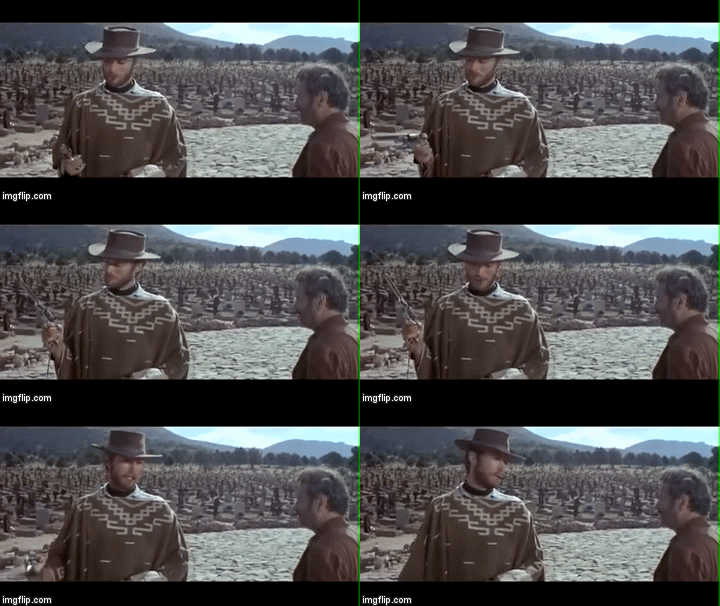
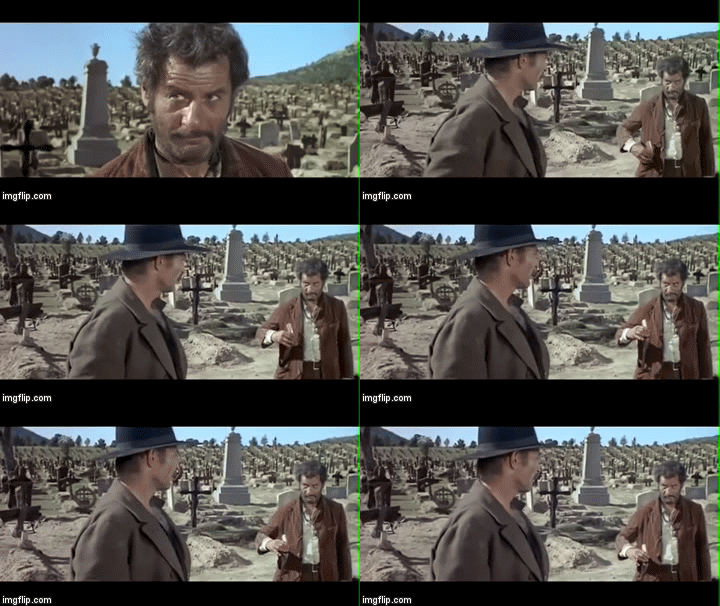
One way in which a story can be told is through the technique of providing and withholding information within the scene. At (7:53) here we can see a 2 shot between Clint Eastwood and Eli Wallach, where Eastwood takes the gun and fires it knowing that it was never loaded. This example of withholding information to the audience allows for the development of drama to unfold, the very fact that the gun was never loaded meant that he was a sitting duck in the stand off, thus leaving the audience in awe of Clint Eastwoods character because he had a plan all along. As the drama unfolds the audience feel as if they have all the information with a building anxiety whilst watching, but the withhold of information allows for a greater appreciation here on after.
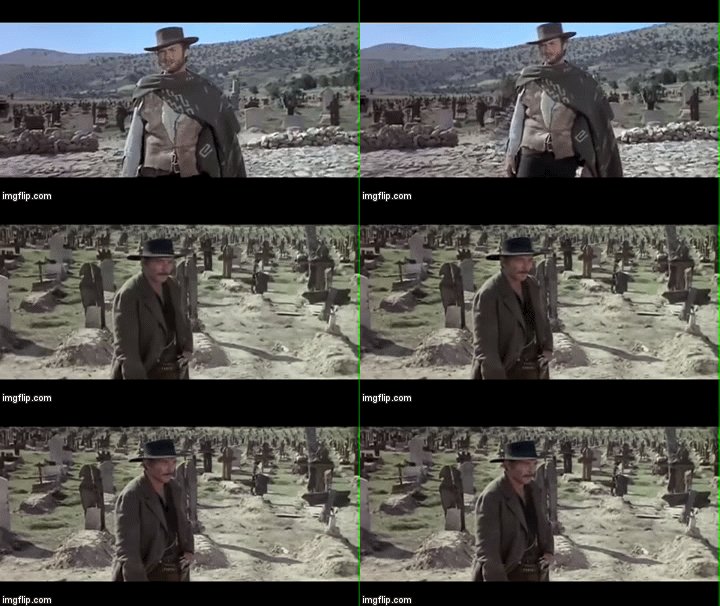
Storytelling can further be exhibited through the use of rhythm and almost cutting to the beat within the film. At (2:34) we see the camera cut to a mid shot of Lee Van Cleef on the beat of the music. Whilst the camera doesnt cut on every beat of the music it does cut in a more rhythmic sense, which does build to the big crescendo at the end. Cutting to the beat and cutting with a rhythmic sense, for storytelling, does create this relationship between the characters and genre of film. It not only creates the atmosphere and builds magnitude for the scene but it also carries this subtle humor through the scene that only a Western can do.


prov&with


cutting to beat


Combining shots into a sequence

Through some editing techniques combining shots into a sequence is a way of adding a certain flow and style to the scenes. The development of the sequence will ultimately reveal events and engage the audience.

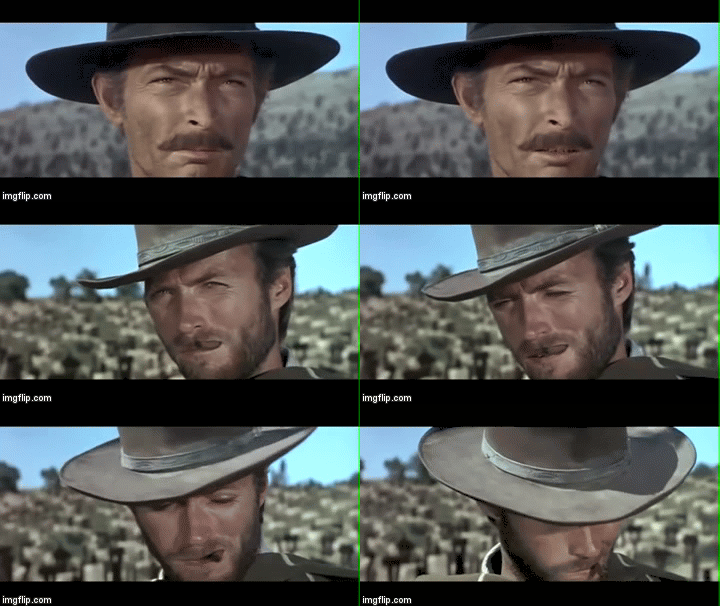
We can see this purpose used through the continuity of the scene, which can be seen at (1:11) this is where the character asks why, but the camera does not dwell on him instead it cuts and almost snaps off him and on to Clint Eastwood. At (1:15) the camera has now cut to show Clint Eastwood, but his time in frame is much longer, the camera holds on for a couple of seconds before cutting to another shot. This ultimately puts the emphasis on the 'good guy' and snaps off the 'bad guy' to distinguish the intentions of both characters. Furthermore, by using this technique it twists the audience's judgment of both characters, whilst this is scene is much later in the film it still continues to manipulate our thoughts even though its late on.
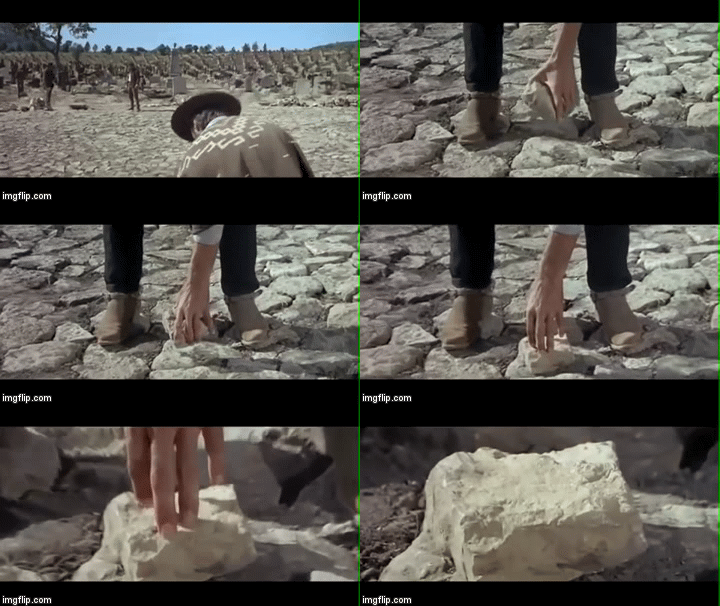
Another way of combining shots into a sequence is through the use of the match on action, which can be seen at (2:10.) Here we see an over the shoulder shot of the two characters as Clint Eastwood is putting the rock down, the camera then cuts to a close up of his hand putting the rock down, ending with the camera zooming into an extreme close up. This match on action technique adds a certain intensity to the scene, it emphasises the unknown and ultimately creates an ambiguity to the shot. Whats different about the match on action in this scene is the way in which the camera zooms. As it is rare for a camera to zoom, in this instance, it carries a more underlying satirical tone, to what is a very intense scene. For the audience it just takes the edge off and continues this unique western style which is serious but also is a little, 'tacky.'


 Continuity


Match on Action


Creating Pace

Creating pace is a way of communicating an emotion more explicitly, it will enhance the audiences feelings through the scene.

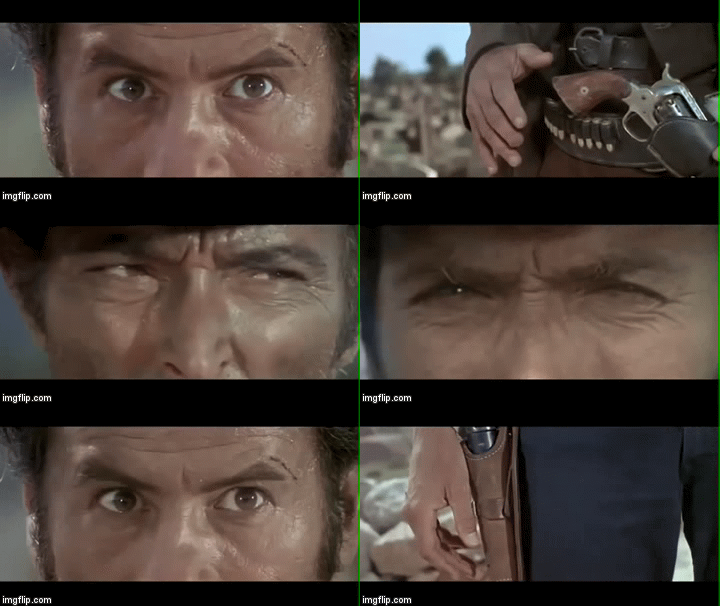
One way that creating pace can be achieved is through the editing rhythm in certain parts of the scene. At (3:06) here we see the character pull out his gun very slowly staring at the other character as he puts it in his holster. He stands there for a long time and waits for the other character to walk away. This deliberate slow paced emphasis during this part of the scene allows the audience to feel the intensity rising. It almost marks the start of the building crescendo, the slow paced action allows the audience to really take in more detail and almost feel the stare out that the two characters are having.
Another way in which pace is created is through a more montage style towards the end of the scene. At (6:37) we see a series of fast paced cuts, that constantly show the three characters faces and their hands that are moving closer towards their guns. The montage is the final stages of this huge rushing, crescendo at the end. The audience are feeling this huge mass of intensity, leaving them on edge as we wait for the someone to shoot. Whilst this montage only lasts a few seconds, from an audience perspective it feels like minutes and thus leaving them with this ever growing anxiety.


Editing Rhythm


Montage

Sunday, 9 October 2016

The Development of Editing

Before Editing

Film began as a single 45 second shot, there was no editing eg, transitions or any other shot to follow. The first use of film was shot on a Cinematographe, an all in one camera which also could be used as a projector and developer. The film had no sound, no colour and was shot in a 4:3 ratio, although very square. 

The first pioneers to create a moving image and film was the Lumiere brothers, they shot the first film called, 'la sortie de l'usine lumiere a lyon' which translates to workers leaving the Lumiere factory produced in 1895. The Lumiere bros however, did not produce the first ever cinematographe, which in actual fact was Leon Guillaume Bouly 1892, instead the Lumiere bros patented the film perforations (holes in the film.) This in turn allowed the film to move through the camera, and thus allowed to create the first film. The film itself is single shot of the Lumieres factory employees leaving, there is no story, no acting or story telling, but rather it is a shot of realism, the camera is set up and they just recorded something very simple. The Lumiere's further produced another film called, 'L'arrivee d'un train en gara de la ciotat'. This film showcased a train that was pulling into the station and framed on the left hand side, whilst by the end of the film people were getting off and on.
Whilst this film was not particularly successful, it was the start of something. It was the start of a moving image that could also be projected on a screen for viewing.

Another pioneer for the start of film would be George Albert Smith, he was perhaps a little more advanced then the lumiere Bros as he used the already made equipment to project a story on screen. His first pieces of work including The Miller & The Sweep, was a short 0:35 second single shot film. It was a comedy stemming from his wife's work in pantomime. His most notable work though came later in 1899 called Santa Claus, this was a longer film at 1 minute 16 and has been said that its the earliest example of crosscutting, which also used a number of special effects created. Smith was a pioneer because he did something different with film, whilst it was not his main profession, he was able to produce something that carried meaning. His work told a story and this was the first time that this could have been done through film and not literature. 


In-camera Editing

In-camera editing essentially was a stop and start technique, it was a cinematographic edit which meant filming in a sequence. The basis of this technique is that everything is strictly shot in the exact order, this would mean that the physical process of cutting the film and editing is eliminated. Whilst this would save time it doesn't account for any mistakes in the process of filming.

Robert W. Paul was the first pioneer to use this technique, his film in 1898 Come along, Do! ran for 1 minute and was the first time that we saw multiple shots in one film. The first shot denotes a simple long shot, much like films before this one, and used a man and his wife sitting outside having a drink before they go into a museum. However, only 38 seconds of the film has survived and the second shot that follows has been lost, this is why we can only see it in stills. However, it still does show the progression of film, the very fact that it did have a second shot meant that we could see a clear example of continuity and a linear format to filming. Robert W. Paul was also the first person to feature reverse cranking, which meant that the film in the camera could be exposed multiple times and create a super exposure. This technique was first used in his film, Scrooge or Marley's Ghosts, which was the oldest film adaptation of a Christmas carol. His pioneering techniques meant that a further story could be developed, it allowed for a continuity sequence and thus an improvement on George Albert Smiths work. This process was particularly easier for editiors, they no longer had to cut and stick the film together multiple times, instead as everything was already strictly shot they just had to stick everything together. 


Following the Action

Following the action was a technique where the camera would cut multiple times throughout the film and 'follow the action.' The technique meant that there was clear examples of continuity editing as well as cutting between two actions. The technical aspects were much harder then anything that had been done before in terms of the camera language and editing.

George Albert Smiths later work though showed a development in editing techniques and the camera language in film. As seen through a telescope (1900) was a film that especially pioneered in the technical aspects of the film. With a duration of 1 minute the film denotes a man standing in the middle of the frame holding a telescope up, the film then cuts to a circle filter acting as the telescope, as we see a woman's ankle. The film then ends with a cut back to man who sits down feeling satisfied but is then knocked off his chair in a slapstick comical way. This film illustrates the evolution of post production, George Albert Smith was able to not only cut and follow the action multiple times but he was able to add in a filter which had never been done before. The ability to change the frame to a circle and carry on the story was exceptionally pioneering to post production and film.  As seen through a telescope was very similar to another film of G.A Smiths called Grandmas reading glasses, which was also created in the same year, showed clear examples of close-ups which at the time was revolutionary. This film used a magnifying glass to again create this circular frame but it also highlighted the use of a close-up. Both films clearly denote this advancement in film and post production, they pioneer in the camera language that they use and the number of cuts & different filters, to really add another element to the story that they tell. This of course meant that the editors job was more intensive, they now had to cut the film precisely so that the film was able to tell the story in the smoothest way possible. But this advancement in film did mean that, for editiors, they had to be more refined which only improved the technical skills of the profession.  


Multiple points of view

This next pioneering technique was the first use of the 180 degree rule in film as well as seeing some crosscutting. This technique meant that the film had to be much longer, as we saw more or the remnants of film like today.

James Williamson produced a film called, Attack on a mission station. The film denotes these Chinese rebel fighters raiding a missionary family, to which British sailors come and rescue the family by fighting off the rebels. This film was the first time that we saw other camera techniques being used, and other editing techniques being used. This film connotes the first use of the 180 degree rule, adding another element to continuity editing. What perhaps set this film even further apart is the first use of, 'match on action' as the sailors come in to shot and run across the screen, the camera then cuts to them continuing to run. This film is perhaps closer to what we are used to in present day, it has a definitive story being told and whilst there are no close ups or filters used in this film, the story is still able to advance through the technical aspects. Attack on a china station was a huge success when released, it is a shame that over half the footage has been lost today, but it does still show clear examples of the techniques. The film was inspired by Georges Melies, 'L'affaire Dreyfus' which was an 11 installment series of the Dreyfus affair that had been happening at the time (1899.) Whilst Attack on a china mission station was not the first war based film it was still something so successful in story and technique that it pushed film forward. Attack on a mission station incorporated a number of technical skills that had never been seen before in a film, it meant that editors really had to be precise about where they cut and how they produced the scene. Editors had never had to cut a film were there was a 180 degree rule or crosscutting had been used before, which mean they really had to learn more in depth of how to construct a scene. 


Shot Variation

Shot variation was an editing technique that allowed for different transitions eg, dissolves, fades. It was the ability to cut between different frame sizes, and have a wider range of shots in one film to produce certain emotions.

DW Griffiths produced the famous, 'The birth of a nation' a film based on the the civil war and the battle between races after. The film was the first to really have length to it with a run time of 133 minutes, and for some people where film all began as it is considered the first ever feature film. DW Griffiths was especially innovative in this film explicitly showcasing very different techniques that had never been done before including, flashbacks, crosscutting, and close-ups. Whilst George Albert Smith had already used close-ups in his work, this was the first time that they carried a specific meaning. These close-ups were meant to evoke certain emotions within the audience and really engage the audience with what was precisely happening in that scene. Whilst the content of this film was radical and shocking to everyone, the technical aspects of this film carried brilliance. DW Griffiths was able to create something that others had been trying to do for years, he managed to turn film into a business, which was ultimately what Lumiere Bros attempted, George Albert Smith attempted to do aswell. Whilst they were pioneers in the industry they were never able to really produce a sufficient business. Dw Griffiths also produced a film called, 'Intolerance' which was 4 stories that were intertwined and parallel to each other throughout the 3 hour epic. The film was believed to be a response to The birth of a nation which was widely criticized for its racism. The film however was not widely received domestically but again was a technical masterpiece and would be  a major influence later on. For editors as this was the first feature film, it meant that they had a much longer time to frame to keep to. This was also the first ever time that editors had to really keep to a structure of scene after scene, and have a concise beginning, middle and end. 


Manipulation of diegetic time and space

This was the first time in film that we saw montage editing or as it was called, 'rhythmic montage.' It was more different to what we are used to today but the idea was still there. This technique wasn't so much a collage of short clips but rather a highlight reel of sorts. 

Sergei Eisenstein produced a film called Battleship Potemkim, the 5 act film where by the crew of the ship rebel against the officers. Most notably is the 4th act, 'The Odessa Steps' this was where for the first time we saw a montage cut to the beat of some music. During the act where chaos is happening on the stairs we see a number of camera angles being used to focus on various pieces of action, and thus creating a montage of sorts. Whilst there is a music composition that happens throughout this scene, it perhaps is more notable where the soldiers seem like they are marching to the music. Eisenstein used the advances in post production, to overlay the music and create this, 'rhythmic montage' which not only was groundbreaking but he also created meaning to it as well. The ending made  it possible for the audience to feel sympathy for the crew as they had lost that particular battle yet it foreshadowed that they would rise up and ultimately win. Of course its main purpose was to create this intense, gripping scene that could be presented in a more artistic way. For editors the use of rhythmic montage allowed them to condense time within the scene, and gives the scene better aesthetics. Whilst it perhaps gives the editors more structure it does give them a more creative freedom with the mix of sound and visuals.


Film,Video

In 1951 video was first invented, yet it took over 51 years for video to actually be used in the production of professional films. It was only until 2001 where video had a superior definition to film and became easier to use.

Once upon a time in Mexico directed by Robert Rodriguez was the first ever film to be shot of digital video as opposed to film. The sequel to El Mariachi and Desparado it was Antonio Banderas last appearance as El Miriachi a drug lord. The film had a budget of $29 million the first big budget film to use the video format, and to release the film in digital format too. For the industry of film it meant that there was a complete technological convergence and everything became easier. It was easier to edit, easier to distribute etc. The very fact that a film could be edited and distributed all on one single device was revolutionary, and much like DW Griffiths it really pushed film into a completely new direction. Video made an editors job more accessible, with film they had to be very careful because it could easily get damaged or lost. But with video all the footage was stored on the tapes, which meant that management and storage became a lot easier when editing a film. 


Analogue

Analogue editing meant that film could be edited through a machine, which was a completely different way of editing as previously everything had been done by cutting the film reel and sticking it back together. Whist this machine essentially did the same thing it was considerably easier for editors. 

In 1917 Iwan Serrurier a dutch born engineer invented the first moviola which its intended purpose was to project film for peoples homes. This moviola was similar to something that already existed called a victrola, this was a phonograph but was redesigned to look more fitting for a home and less like a whole machine. The moviola was not selling well to the public in america as it cost so much, in 1924 Iwan adapted the moviola machine so that editors could use it, rather then being a projector it became an editing machine. This piece of equipment changed post production, it wasnt so drastic like digital editing but it did change the way editors edited. The whole process became easier and faster, the machine also allowed for different transitions to be used and this allowed for post production to again change its ways. For an editor the moviola didn't necessarily mean their job got easier, but it did give them their own machine and their own space to edit from. Whilst the moviola was a very, 'hands on' machine it allowed editors to have a trust and a confidence in editing, the machine never changed and they could learn and know every part of the machine. 


Digital

Digital editing or non-linear editing was a non destructive way of editing, there was no physical cut of any film reel, and everything was done on computers, opposing moviolas. 

The first non-linear editing system was the CMX 600 introduced in 1971, however it was low-resolution and only in black and white making this product not fit for professional editing. During the 70's and 80's various editing systems were invented but nothing substantial came until 1985 when Ediflex was invented. Ediflex was used professionally for many years, whilst new systems and software where being invented however most failed. 'Lets kill the lawyers' was the first film that was completely edited on a PC, directed by Ron Senkowski and was based on Shakespeare's Henry VI play. The film was not widely received by anyone and had reviews calling it ,'a bad homemade film.' However the main point of the film is that it was the start of something, much like the Lumiere Bros back in 1895 there was a revolutionary idea with this film. The start is never easy and whilst perhaps it was easier to use older techniques that had been perfected this was a format that would again push post production forward. Digital editing on a PC was and is easy there is no destruction of footage, and content can be edited faster and cheaper and it allows for more special effects to be added. By having multiple software's to edit on, it means that anyone can learn to edit, we no longer need big units to cut up film, but rather all we need now is a computer. The advancement of digital editing packages has meant that editors now have a much easier job altogether, from storing footage to having multiple cuts of some footage, as well as the added advantage of no longer loosing footage that easily anymore. 

Other notable software's such as final cut were invented in 1998, Adobe premiere pro wasn't invented until 2003 whilst Apples Imovie was invented in 1999. 


Sunday, 25 September 2016

Editing Conventions and techniques

Seamless/Continuity

Continuity editing is simply the flow of the edit, its he sequence of clips all put together in a timeline, making sure that the whole scene is fluid and seems natural. Continuity editing makes sure that nothing in the scene is out of place eg props that have moved or any of the background set.

Often sitcoms will use continuity editing as such in Friends, because they typically want to make each scene very fluid for the audience to really pay attention to the humor. This scene from Friends is an example of continuity editing which can be seen at (0:25) the scene denotes Ross coming into the apartment, we see him in a mid shot with an etchy-sketch hanging on the door, reading, 'Joey-Call Kim.' The scene then cuts to the other characters to see there reactions at (0:35) it then cuts back to the same shot of Ross with the same background. This scene connotes the use of continuity as the whole background is kept the same way throughout the whole scene. This technique is used to allow the audience to follow the scene smoothly. If everything is always in the same place throughout then the audience don't have to think too much about what they are watching. Furthermore, it allows the audience to feel immersed in the programme/ film.

I have used this technique in many of my projects more specifically my project called, ' The Encounter' this was a piece that i really focused on the skill of continuity. Whilst it seems like a simple skill it does require some thinking about the props placements throughout the scene.


 Motivated

Motivated editing techniques are quite simply when something is not in frame but the character hints at it, to which the camera will later cut to it. Motivated editing almost acts as a reveal typically used in Horror films or flashback scenes. 

During this scene of The Dark Knight Rises we see the motivated technique used as a flashback scene. Here in the present time, the characters hint at something which is later revealed in the form of a flashback. At (0:26) we see Batman ask Bain about the pit and if he was the child of Ra's al Ghul, Miranda then comes into shot stabbing Batman and revealing she was the child of Ra's al Ghul and that Bain was her protector. We then cut to a flashback of how she climbed up and escaped the pit leaving Bain behind. This motivated technique allows for information to be revealed to the audience,it allows for a big reveal and shows the audience that they may have thought was wrong. In a more conventional style the motivated technique would make the scene more tense, however in this instance the whole point of the technique is to stab Batman in the back and leave the audiene feeling shocked.


Montage

This editing technique is the use of many small individual clips that are all added together as such of a collage. They are molded together to create a package, typically used to excite the audience, and will always use multiple locations.

Montage editing can be seen mainly in Film trailers much like Mad Max Fury Road. This trailer uses a rapid montage at the start which comes to an anti-climatic fade, the trailer then proceeds with the montage style but the shots are much longer. The Mad Max Fury Road trailer uses a montage style throughout but from the start till (0:19) we see the technique used more specially. Throughout the start of the trailer Max is constantly running but in the edit it rapidly cuts to different parts of the scene, flashbacks, different camera shot types. The use of the montage style is designed to keep the audience engrossed. The style has this suspenseful, anxious tone to it which in turn keeps the audience watching as it leads to either a big climatic reveal or in this instance it fades out to create this anti-climatic feeling and carries on with the rest of the trailer with a voice over from Max. This technique does allow the trailer to move along at a very fast pace, which carries this unnerving tone for the audience.

In my own experiences i have done some montage editing with my showreel. My showreel contains a sequence of many different shots that i have produced over the course of a year. Whilst it may seem easy using this style i still needed to really think about how it would flow nicely.


Jump-cutting

Jump cuts are a technique where the camera stays in a stationary position but the action/scene jumps forward in time, still in the same location though. Jump cuts typically jar the scene but are used for that very effect.

This scene in Spiderman 1 use the jump cut technique to mock Peter Parker. At (1:45) we see the camera in a low angled extreme close up, to which Peters hand cuts in and out trying different hand gestures to produce a web. The technique used is used in this instance for audience to laugh at him trying all these weird movements. The audience are allowed to laugh at his many attempts at creating at web. For the audience it typically allows them to only watch the more important parts of the scene. But in this instance it creates the humor by showing every attempt and amount of time he spends. This is typical the opposite of a more conventional jump cut as they do aim to move time forward.   

I used this technique very early on last year creating short videos expliclty showing the technique. Whilst this video is not the most precise expression of the technique it does still emulate the overall meaning of a Jump-Cut. Some of the cuts in this scene are very good however the timing of the cut is very key, its not conventional to dwell on a shot too long but equally cutting to scene can create a more dramatic jarr.


 180 Degree rule

The 180 degree rule is simply the camera staying on one side of two people who are opposite each other in conversation. The only time the camera can move on to the other side is if it tracks behind a character as they continue their conversation.

Perhaps whats different in this case is the fact that there is no cut. As the action moves the camera constantly follows, so the distinctiveness of the 180 degree rule is very blurred. At (0:04) the scene denotes a close up of the character as she talks to Micheal Keaton, the camera slowly tracks out and round bring Micheal into frame. The camera then lingers in a two shot, and finally swoops round to the left to see Micheals full face. The 180 degree rule is deployed here as we only stay on one side of the characters during their conversation. What perhaps is more unique is at (0:30) the camera comes back to a more central position to allow Micheal to walk in front, which in turn allows for another angle/side for the camera to stay on. From an audience perspective the main purpose of the 180 degree rule is for the audience not to get confused during the scene. It allows the scene to look more natural, so that the audience dont have to think to much whilst watching the scene.  

In my own experiences i have used the 180 degree rule when i filmed the, 'Top 10 tips for interviews' at (0:18) the camera starts on one character and pans right to frame another character, becoming a 2 shot. Further on in the scene we cut to one side of the employer (0:24) and continue to stay on that side throughout the scene. Whilst we perhaps needed more camera movement in the scene to show we stay on that one side, it does show an understanding of the rule.


Splicing/Transitions

Splicing is simply anywhere there is a cut in the medium. Any transition eg, cut, fade, dissolve is a form of splicing. A transition though is the movement from one shot to the next it can be any type of transition but typically it is a cut. 

Any film scene could have been an example of splicing, much like this scene in Interstellar throughout, the camera cuts which are all examples of the splicing technique. At (0:14) we see Coop turn off the engines and tell the others to be efficient with this rescue mission as they dont have much time, the camera then cuts to the other characters who prepare to leave. This of course is an example of a cut which is splicing. Splicing is simply a way for scene to move on and get to another point, a cut can create a certain emotional tone depending on the pace of them. In terms of fades and dissolves they are used more subtly and act as a more calming transition for the audience.

Of course through my work i have cut and spliced mediums, during this film which is of 2 people showing off their skills, at (0:45) we see a cut and then someone trying to hit the crossbar. Making a cut whether its in a film scene or more of a highlight reel, whilst it is easy, i still needed to think about why im cutting now and what purpose does the shot have. It perhaps is harder to explain why we use a shot and what the cut does to the emotion of importance of the shot.


Cutaways

Most cutaways effectively are a filler shot, they are used so that they can edit certain parts of a conversation or interview and move time forward without the viewer noticing. However cutaways may also be for emotional purposes as they can carry meaning and direct the audience in how to feel at the time.

During this contestants performance we see multiple cutaways to the judges reactions. At (1:41) we see the first cutaway which denotes Amandas and Simons reaction to the start of the performance. They look at each other more anxiously as to whether this performance will be good or bad. Further into the performance we see another cutaway at (1:55) this time its David and Simons reactions as they laugh from the performance. This cutaway though reassures the audience that the performance is good and we can laugh with him rather then at him. Furthermore at (2:25) the cutaway again features Amanda, as she is more surprised and excited by the performance she is watching. The use of cutaways allows the programme to structure the audiences emotions, we start with some anxious cutaways to bring the performance on to a knife edge, to which later it becomes a happier ending. These shots to the audience perhaps go more unnoticed, we recognise the emotion of the judges and we might identify with them but perhaps we don't fully understand that they have shaped our emotions as well. 


 Point of View shot

A point of view shot or POV shot, is where the camera takes the position of the character, we look at the scene from their perspective. Typically these shots last longer to add a more dramatised effect.

During this scene in the Big Bang Theory we see the use of the point of view shot multiple times, at (1:02) we see the first use of a POV shot as Raj looks to the other characters on advice as to what to say on the phone. This technique is used throughout the scene, this adds a more melodramatic humour to the scene as we become Raj. At (1:20) we see the technique used again but this time for a much longer time (10 seconds), the other characters deliberate much longer about what Raj should say next. This in turn allows the audience to laugh more bout the whole situation and keeps them more immersed in the scene. In this instance the POV shots are used for a comedic effect, whilst this shot is more rare to see in TV that in itself allows for the scene to feel more fresh and less repeated.


Shot-Reverse-Shot

Shot-reverse-shot is where the camera starts on one character cuts to the other character then back to the first character. This technique would typically happen in a conversation, and generally only happen in a midshot to close up.

During this scene in Spiderman, we see a shot-reverse-shot being used when Norman osborn talks to the Green Goblin. At (1:25) we see the conversation take place with a mirror as they talk about the board members being killed. What is more memorable about this technique being used in this scene is the mirror, one character is playing 2 roles. Of course this has been done before, but it creates a confusion surrounding this scene, as the green goblin character is trying to take over there is a struggle within the character. Whilst the aim of a shot reverse shot is to not jar the audience because it mimics how we really follow a conversation, this scene perhaps intentionally jars the audience. The scene wants the audience to be confused, it creates an anxiety surrounding the character as we ultimately know the Green Goblin will take over.

Last year I learnt how to use this technique by creating a short film all based around a shot -reverse shot. At (0:10) we see me asking about what happened last night, the camera then cuts to another character at (0:11) explaining what did happen, to which it then cuts back to me remembering and talking about the night before. This technique was a lot easier to learn and do, because it is an easy camera set up, but i did learn that it can make a scene relatively easy to shoot.  


Providing & Withholding information

Providing information means that the audience know some information that a character does not, this typically sets up another scene for when a character is told the information that we already know to see their reaction. Moreover, withholding information happens when the character in the scene knows more then the audience do, we are left in the dark until it is revealed to us. This typically happens in a scene of great importance as it is surrounded by suspense.

During the film Kidulthood we see an example of providing information being used at (13:55) this is where the character finds out she is pregnant but the father does not know yet, from the music that plays over the top the main lyric is, 'positive' which provides the information to the viewer that she is positive. From an audience perspective, the providing information technique it creates a moment of reveal. Now that we know she is pregnant but the father doesn't sets up another scene where it will be revealed to him. This in turn creates an increase in tension and anxiety as the audience and the character both wait for the scene to tell him.

Though, in this scene from Now You See Me 2 we see the withholding information technique being used, as at (1:26) Jesse Eisenberg is performing a street trick, whereby he makes the rain stop and then move it up defying gravity. The technique is shown at (4:15) as he reveals how the trick happened to the audience in the film and to us the viewer. This technique much like providing information typically is used to create tension, but in this scene it more creates excitement. Much of the time we don't get to see how the trick happens but in this instance we are perhaps more appreciative that they showed us.


Editing Rhythm

Editing rhythms are a deliberate change in pace of the scene, the scene may speed up rapidly perhaps if drugs have just been taken or they may choose to slow the scene down almost in a slow motion, because there is a struggle that a character is going through. This technique is used to really create atmosphere and emotion in the scene.

Requiem for a dream is a film based on drugs, the film uses a certain editing rhythm to add to the feel of some of the scenes. At (0:55) the scene denotes, both characters laughing, and acting very slow, because they have just taking drugs. The camera slowly zooms out and into a fade as the characters continue to laugh in their high. The use of this technique allows for the scene to be enhanced, and allow the audience to feel they have almost taken the drug as well, because we can really understand what it feels like. Whats different about this film is the process of taking a drug, at (l;46) we see this montage scene which shows all the elements of taking a drug, which ends with the pupils dilating. The montage though is very fast with quick, loud sound effects, it would seem a more deliberate choice to add a fast paced effect, to again enhance the scene and allow the audience to feel more engrossed in whats happening.


 Parallel editing/Crosscutting

Crosscutting happens where 2 scenes are happening simultaneously, and we cut between both scenes. This technique is used to show the audience that both things are happening at the same time and usually create a lot of suspense and excitement during the 2 scenes.

Through this part of the Dark knight we see crosscutting being used, to exhibit how both scenes are happening at the same time and who the mob is going to get next. At (0:19) we see Harvey Dent and Rachel at a party, talking by themselves. The scene then cross cuts at (0:30) to show Lt. James Gordon in his office talking about how to stop the mob from killing the Commissioner. Perhaps whats unique about the technique used here is that there are not 2 scenes simultaneously happening but rather there are 3. At (0:08) we see the Judge being escorted to her car and told to drive to an unknown location in the envelope. Crosscutting allows a relationship to be established between the scenes, in this instance it is the characters that are all threatened by the mob that are being moved. For the audience it allows for tension to build, they feel more immersed, and increasingly feel anxious for the characters. The technique used here allows for the big climatic ending to happen.


Cutting to Soundtrack

Cutting to a soundtrack or cutting to a beat, is where the visuals are cut on a beat of the music continuously throughout. They are specific structured cuts that will happen every time on the beat.

During Logic's All i do, we see the technique used throughout the whole music video. At (0:54) which denotes the technique being used in a more conventional way, as the location constantly changes through a cut on the multiple beats. The locations we see would be the party, bedroom & park. However, at (1:31) we see the technique used more differently, here we see the cut on the beats, but also there are multiple cuts on the piano as well. Perhaps the music video did not have a big budget and throughout the use of this technique they have been able to keep the music video more lively and keep the audience more engaged. The whole music video only contains a few locations, so cutting to the beat was an effective way of creating and keeping the excitement a constant through the whole music video. Furthermore, the technique enables the flow of the song to be enhanced, which for the most part carries a more calm, chilled vibe, of course during the verses the flows tempo increases, which is replicated in the number of cuts used.

During my music video i too learned and used this technique throughout. At (0:31) the character walks up the stairs as we cut from behind her to in front of her and then cut to her hand dragging behind. Whilst our music video was more of a simple idea, the success of it depended on the style we created. This included the use of this technique, which whilst at first seemed challenging we did manage to find success although very time consuming. At (0:58) which is on the second verse, i felt that this was a more clear representation of the technique being used. Much like Logic's music video we didnt have a big budget to work with so we needed to make the most of every location and we felt that this technique continued the style that we wanted.